
Five countries in nineteen days sounds like a logistical nightmare. That's why I put Central Asia off for years — and why, when I finally went, I went with a group rather than stitching five borders together myself.
I should have stopped waiting sooner. This is the middle stretch of the Great Silk Road, and it's a far easier place to travel than its reputation suggests. I didn't want to pick two countries and promise myself I'd return for the rest, because I never do. So I booked a 19-day tour through all five Stans from “Arara” tour agency and started counting down. My partner had used up his vacation days back in spring, so he stayed home and made me promise a photo from every border crossing. I kept that promise. Mostly.
Kazakhstan: apple trees and a hundred-year-old bazaar
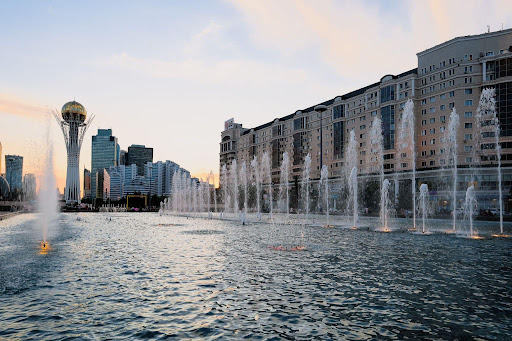
We landed in Almaty in the morning, checked in, and were out sightseeing before the jet lag had a chance to argue. Kazakhstan is the ninth-largest country in the world, our guide told us on the drive in, and the most economically secure of the five. Almaty has a confidence I wasn't expecting.
The city is green in a way nobody warns you about: streets lined with apple trees, mountains sitting on the horizon like part of the skyline, parks that make you sit down whether you'd planned to or not. We worked through Panfilov Park, the Zenkov Wooden Cathedral, St. Nicholas Cathedral, the National Musical Instruments Museum and the Central State Museum.
But the Green Bazaar is what I keep going back to in my head. There's been trade on that spot for roughly a century, our guide said, and it smells like it, in the best sense: herbs, spices, wheels of cheese, dried fruit, a dozen things I couldn't name and bought anyway. The vendors were relentless in the friendliest way, pushing samples at us and asking where we were from before we'd decided whether we were buying. I left with more than I could carry, plus a scarf I'd picked out for him at a stall near the entrance. I sent a photo. He replied: you've been in there four hours.
Kyrgyzstan: The drive nobody talks about
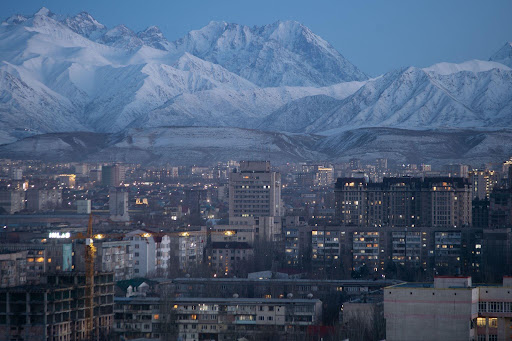
On day four we crossed into Kyrgyzstan and drove to Bishkek. That drive earns the border paperwork on its own — empty mountain passes, pastures that go on far longer than seems reasonable, yurts at the roadside, herds moving across the grass with shepherds walking behind them. Half the bus stopped talking. On a group tour, that never happens.
Bishkek we took slowly: a walk with our guide, the main square, another bazaar. But the day I'd keep was the one we left town for Issyk-Kul — the legendary lake, seventh deepest in the world and the second-largest saline lake after the Caspian. We didn't do much there. We sat on the shore and let it be beautiful at us for a few hours. After a solid week of monuments, that was exactly right.
Kyrgyz food is hearty and unfussy: lagman, manti, samsa, kumys. Food built for long distances and cold mornings, which is presumably the point.
Uzbekistan: the part that ruins you for other countries
Uzbekistan is the heart of the Silk Road and, without much competition, the most historically rich country in the region. We started in Tashkent — a packed programme of monuments, madrasahs, bazaars and museums, barely a gap to sit down in. The capital layers a modern city over old bones and mostly gets away with it. Then came Samarkand, Bukhara and Khiva, which between them made me lose track of what century I was standing in.
Registan Square in Samarkand became my favourite thing of the entire nineteen days. The mosaic across the three madrasahs is colour laid on colour, the geometry repeating until your eye gives up following it. The blue minarets climb into a sky almost the same shade, so the buildings dissolve upward at the edges. I stood in the middle of the square doing nothing for a long time, being slightly ridiculous about it. Eventually I took a photo and sent it, knowing perfectly well it carried none of the thing. He wrote back: I can tell you're crying. Fair.
Go and stand there. Photographs don't work on it.
Tajikistan: one night, not enough
Tajikistan was our shortest stop — a single overnight, which felt like an error by the time we left.
We visited Panjakent, a city with a history said to run back some 5,500 years. There were centuries when it was one of the country's great centres of craft and culture, and it's been called the “Central Asian Pompeii” — a comparison you understand rather than tolerate once you're standing in it.
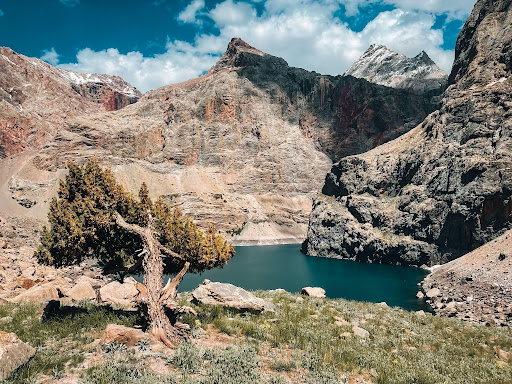
Then the Seven Lakes: seven of them stacked up a single valley, each a different shade of blue, green, turquoise or purple. It sounds like brochure copy. It isn't. They really are different colours, one after another, and the sequence is the point.
The food here is home-cooked and satisfying — soups, sambusa, pilaf, qurutob, eaten the traditional way, with your hands and without hurrying. Our host watched me fight the technique for a full minute before quietly demonstrating. I improved. Not to competence. But I improved.
Turkmenistan: the strangest place I've been
Turkmenistan felt unlike any of its neighbours — more closed, more formal, quietly surreal. Ashgabat, all white marble and enormous empty avenues, reads like an architectural oasis dropped into the desert. Everything gleams. Almost nobody is on the street. I still haven't decided what I think about it, which is the best souvenir a country can give you.
Beyond the capital is a different world again: the ruins of ancient Merv and Nissa, and the Karakum, which does things with light I don't have the vocabulary for.
The high point — of Turkmenistan, and arguably of the whole trip — was the Darvaza gas crater. Fire coming straight out of the ground, in the dark, in the middle of nowhere. You hear it before you're close enough to feel it. Nobody in our group said much. There isn't much to say.
The food is plain and filling: meat, flatbreads, pies, and the famous sweet melons, which deserve every bit of their reputation.
Going home
Five countries, nineteen days, one badly overloaded suitcase. If you've been circling this region for years the way I was, waiting until you have the energy to plan it properly — don't. Let someone else handle the borders. Go and stand in Registan.
He's coming next time. I extracted that promise at the airport, before we'd even boarded.


Comment (0)