
There is a particular kind of holiday sleep that feels almost theatrical. You fall into cool white sheets, disappear for nine hours and wake up wondering whether somebody quietly replaced your nervous system overnight.
It is tempting to credit the hotel mattress, the sea air or the fact that breakfast involves miniature pastries. Those things can help, but the real answer is usually a collection of small changes. On holiday, your days send clearer signals to your body, your mind carries less unfinished business and the bedroom asks less of you.

Your brain has fewer tabs open
At home, bedtime often arrives while your brain is still holding tomorrow's meeting, a washing load, an unanswered message and the vague sense that you should have done more. Even when you are physically still, your attention remains scattered.
A holiday does not remove every worry, but it interrupts their usual cues. You cannot deal with the laundry because it is in another country. The work laptop is closed. Tomorrow may require nothing more complex than choosing between the beach and the pool. That psychological distance makes it easier to stop monitoring the day and surrender to sleep.
You move more without turning it into exercise
Holiday movement is often constant and unremarkable. You walk through an airport, explore a city, swim, climb steps to a viewpoint and wander out again after dinner. None of it necessarily feels like a workout, but it builds genuine physical tiredness.
At home, many people move from bed to car, desk, sofa and back to bed. A hard gym session can be valuable, but so can the gentler accumulation of movement across an entire day. The holiday version often leaves the body pleasantly ready for rest rather than wired by a late, intense session.
Natural light is doing more work than you realise
Breakfast outside, a morning walk and hours spent near windows expose you to far more daylight than a normal office day. Bright morning and daytime light helps reinforce the difference between day and night. Then, in the evening, holiday life often becomes naturally dimmer: dinner, a stroll, a book and bed.
At home, indoor light can be relatively flat all day before bright overhead lights and phone screens extend the evening. The body receives a much muddier set of timing cues.
The room has one job
A good hotel room is designed around arrival and rest. The bed is made, the surfaces are clear, the lighting is layered and there is no pile of clean clothes waiting to be put away. You are not sleeping beside your admin.
The physical centre of the room matters too. If you want to recreate that hotel-bed feeling at home, start by considering premium bed frames and then pay attention to the details around them: breathable bedding, pillows that suit your sleep position, effective curtains and a comfortable temperature.
The goal is not to make your bedroom look anonymous. It is to remove the tiny irritations that ask for decisions when you are already tired.
You stop rationing sleep
On holiday, going to bed at 10.30pm can feel luxurious. At home, the same bedtime may feel like surrendering the only free part of the day. This is sometimes called bedtime procrastination, but the emotional logic is understandable. If the day has belonged to work and obligations, staying awake becomes a way to reclaim it.
Holiday days contain pleasure, autonomy and pauses, so bedtime does not have to carry the burden of being your only personal time. You also give yourself a longer opportunity to sleep because there is no commute waiting at the other end.
You follow rituals without calling them a routine
The last hour of a holiday day is often beautifully repetitive. You come back, shower, put on clean clothes or pyjamas, talk about the day and decide what to do tomorrow. The sequence tells your body that activity is ending.
At home, the final hour can be a jumble of television, emails, skincare, snacks and scrolling. A strict routine is not essential, but a recognisable order reduces the number of decisions between being awake and being asleep.
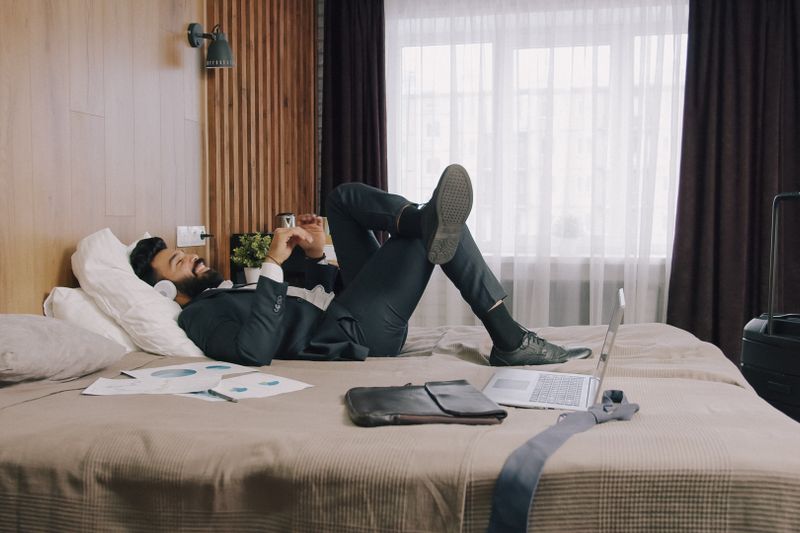
How to bring holiday sleep home
Begin with the parts that do not require a room-service budget. Get outside early in the day, especially if you normally work indoors. Add more walking to ordinary life. Give yourself at least one pocket of genuine leisure before bedtime so you are not trying to steal it at midnight.
In the bedroom, clear the immediate view from the bed, lower the lights in the evening and prepare what you need before you are exhausted. Keep work away from the sleep space where possible. If your thoughts become loud when the room becomes quiet, write tomorrow's tasks down and close the list.
Finally, allow enough time. A beautiful bedroom cannot create eight hours of sleep inside a six-hour window. Decide when you need to wake, work backwards and protect the start of that window as seriously as the alarm at the end.
Your best sleep is evidence, not a fluke
Sleeping well on holiday does not mean you need to abandon your life and move permanently into a boutique hotel, tragic though that may be. It shows that your body can sleep deeply under the right conditions.
Notice which conditions changed. Was it the walking, the daylight, the quiet, the cooler room, the absence of work or simply having enough time? Bring home the two or three elements that made the biggest difference. The souvenir may be less glamorous than a bottle of local wine, but it will improve far more Tuesdays.
Featured image by cottonbro studio from Pexels.



Comment (0)